Noah & the Flood
What Are We Living For?
The story of Noah, found in Genesis 6–8, is one of the most memorable in Scripture. Many of us first heard it in childhood, but it carries far deeper meaning than animals and rainbows—it reveals God’s judgment, mercy, and the call to live by faith.
God judged the world for its wickedness with a flood, yet showed mercy by sparing Noah, his family, and the animals. Noah’s faith was proven in obedience—he built the ark exactly as God commanded, even while others mocked. After the flood, God made a covenant with Noah, giving humanity a new beginning.
This story is more than ancient history. Just as wickedness filled the earth then, it will again. One day Jesus will return, God will judge the wicked, and salvation will be found only in those who are in Christ.
What Are We Building?
What were people doing in Noah’s time while he built the ark? They weren’t just mocking him—they were living their lives, making plans, building futures, and ignoring God. They thought Noah was wasting his life on something pointless.
We often imagine their wickedness as drunkenness and wild sin, but the Bible shows something deeper: “Every imagination of the thoughts of his heart was only evil continually” (Genesis 6:5). Their true sin was living without God, following their own desires, and shutting Him out. The people of Noah’s day had no intention of ever turning their lives back to God. If they had, He would have shown mercy instead of judgment.
Some may have even believed in God’s existence, but they didn’t believe God—didn’t trust Him enough to obey. They couldn’t accept a God who asked for sacrifice, like asking Noah to build an ark that would take most of his life, instead of simply giving them whatever they wanted.
Noah, by contrast, believed wholeheartedly. He trusted God’s word, followed His commands down to the smallest detail, and built what God told him to build. While the world pursued its own dreams, Noah built his life on God’s will.
This raises the question for us: What are we building with our lives? Are we devoting ourselves to God’s purposes, or are we focused only on ourselves?
Jesus said people in the last days will be living just like in Noah’s day—“eating and drinking, marrying and giving in marriage” (Matthew 24:38)—blind to the coming judgment. Are we living as if this world is all that matters, or are we preparing for eternity?
Our lives can end at any moment. Are we storing up treasure in heaven (Matthew 6:19–20), or are we clinging to this world that will one day pass away?
The Flood Comes
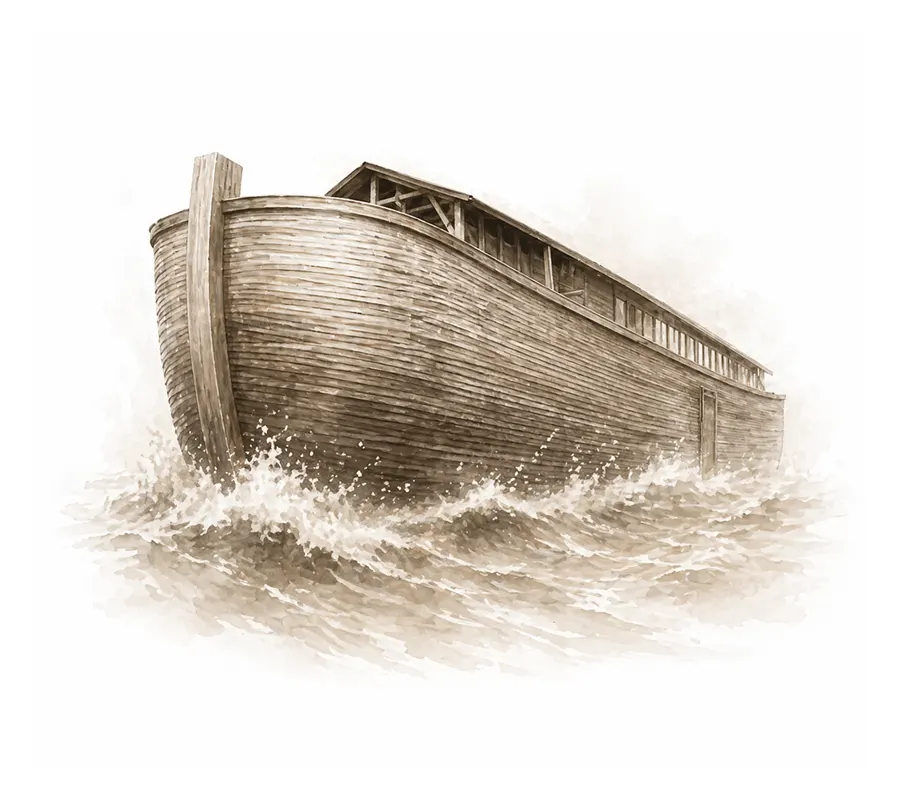
For forty days and forty nights, rain poured upon the earth like relentless bullets from a machine gun. Noah and his family were shut inside the ark—surrounded by one another, enclosed with the smell and noise of animals, and covered by endless darkness with no sight of the sun. Days turned into weeks, and weeks into months, until they had been in the ark for over a year.
At last, Noah sent out a dove to see if the waters had dried and the earth was ready again, longing to step onto solid ground. Imagine the weight of that experience—the confinement, the silence broken only by the storm and the animals, the absence of light, and the haunting knowledge that the world they once knew was gone, and every person outside the ark had perished.
The ark is a shadow of Christ—our true Ark of salvation. As we journey through this dark and fallen world, carried by currents that run against God, we must enter into Christ and remain in Him. The world pulls us toward destruction, but in Him we are kept secure.
Like Noah facing storms, we also endure suffering, pain, persecution, and the raging tides of a world opposed to God. Yet if we have the faith to build our lives upon Christ—to trust Him, abide in Him, and walk in obedience—we will be carried safely through the flood.
And on the day when God wipes away all that is ungodly, those who are found in Christ will be raised, standing on new ground, delivered into the promise of eternal life.
It is not always pretty, comfortable, or smooth, but it is the only life worth building—the only refuge that can truly save us.
What’s at Stake?
In Noah’s day, the earth was destroyed by water; one day it will be destroyed by fire (2 Peter 3:7). Noah’s obedience saved him, while the world perished. He spent his life learning to trust God, and his faith was rewarded.
The same choice stands before us. Are we trusting ourselves, or trusting God? Are we building according to our own plans, or according to His?
Some of us may be building a kind of “ark” of our own making—a faith that looks spiritual but isn’t anchored in obedience. But will that ark float when the storm comes? Are we half in the world and half with God, hoping to get by with compromise?
Noah lived 950 years, but what marked his life wasn’t its length—it was his trust in God. In the same way, our lives will pass, but what will matter is whether we walked with Him.
Final Reflection
Is your heart fixed on this world, or on God’s kingdom? When the end comes—whether for the world or simply for your own life—will you be found building on Him, or on yourself?
Like Noah, will you live by faith, or will unbelief cause you to perish?