
Christianity
Examine Yourselves (2 Corinthians 13:5)
Examine Yourselves ↴
Quick Links
Have a Question?
Examine Yourselves
3 of 11 Pages
Is Your Faith Real?
Where Genuine Christianity Is Proven
How God Tests What We Truly Believe
In God’s economy, testing reveals whether our faith is genuine and mature. While many resist the idea of being tested, testing is woven into life itself—it exposes what is false. God does not test to harm us, but to anchor us in truth and assurance, especially when our souls are at stake (James 1:2–4). Every Christian is tested for authenticity, and so is the church, for the church is nothing more than the collective faith of its people.
Precious Metals and Jewelry: Gold, silver, and platinum are tested using methods like magnet tests (gold is not magnetic), acid tests, density (float) tests, and examining hallmarks for purity. How does God test the maturity and the genuineness of our faith? God tests us through circumstances—through struggles and persecution, in good times and in bad (1 Peter 1:6–7). Every moment of our lives is a moment of testing to see if we will produce faith or faithlessness.
What Does Testing Bring?
Testing draws us closer to Christ. It matures and strengthens our faith, producing assurance (Romans 5:3–5). Without testing, faith remains immature—leaving us as spiritual infants, if truly saved at all. When faith is never proven, assurance is impossible, and uncertainty weakens our walk and ultimately brings dishonor to our Lord.
Where Does Testing Happen?
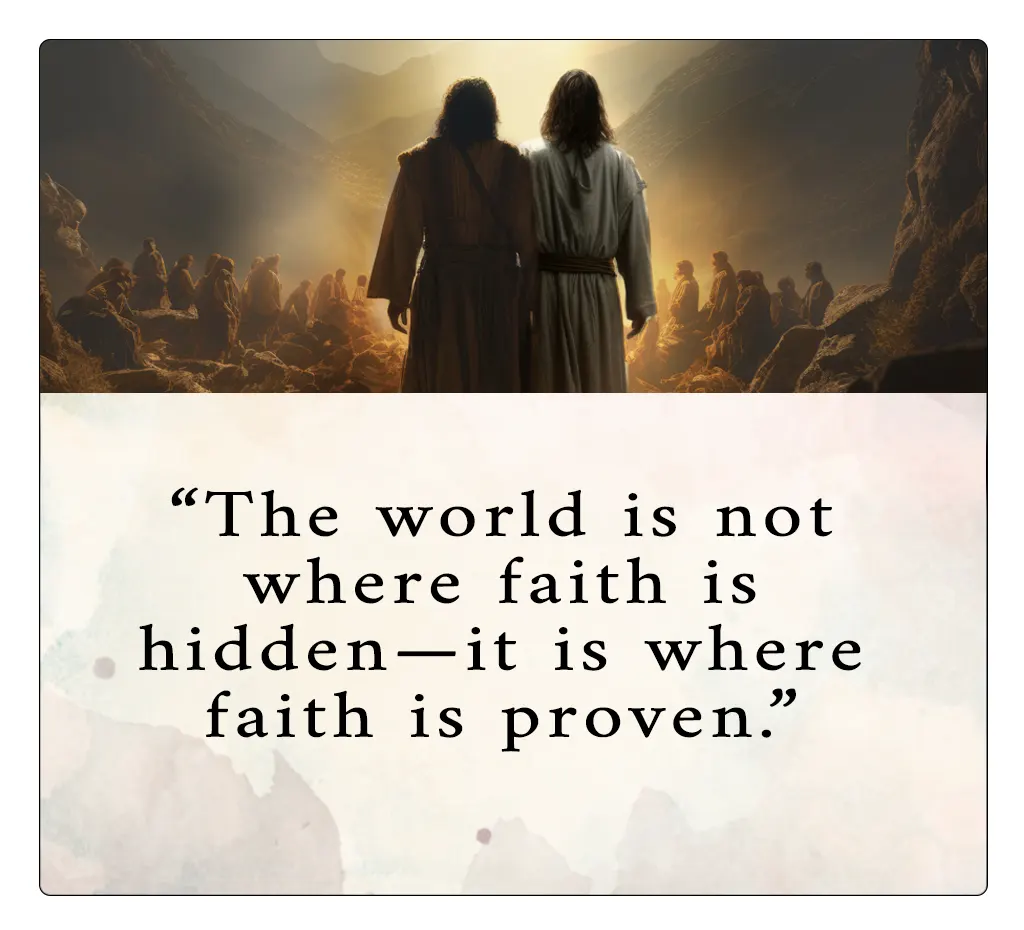
Testing happens in the world—everywhere we turn. It meets us at work and at rest, in our relationships with friends, family, and even enemies. This world is the proving ground where faith is revealed: whether we truly live by faith, know God’s Word, walk in obedience, respond with trust, and rest in the certainty of God’s love (Matthew 5:13–16).
The problem is that many Christians have learned how to sidestep testing altogether, redefining what it means to be a true and mature believer. Genuineness is often reduced to having once prayed a prayer. Testing, meanwhile, is kept safely contained within Christian bubbles—inside church walls and among Christian friends.
Growth is no longer measured by inward transformation, but by outward activity. For years, I measured my own faith not by spiritual growth, but by how much I was doing in ministry.
The modern church often reinforces this confusion by creating an atmosphere where believers can hide, remain comfortable, and still be told they are growing. While people may be encouraged to “step out in faith,” that testing is usually limited to serving within the church itself—a controlled environment that rarely demands much faith at all.
Sadly, success is often measured by attendance and volunteer numbers rather than by lives transformed beyond the church. A healthy church should not be concerned with whether people merely come and go, but with whether they are making a real difference in the world by serving the world.
A faith like this is a faith of convenience and compromise—safe, untested, and largely ineffective in the world. It avoids persecution, trials, struggles, seeks its own, and makes very little difference in the world (2 Timothy 3:12).
Why does God allow Christians to wander, suffer trials, and face persecution? It is so that we may be tested and grown through it. Why are we called to be Christlike? Why are we commanded to be light and salt, to love our enemies, and to go out into the world? Because these are the very means God uses to test and mature our faith—so that, in the end, He is glorified (John 15:8).
This is part of the Christian calling. If you want to put your faith to the test, this is how success is measured: step into the world and examine the genuineness of your faith. Will you respond in a Christlike way, showing that Christ is in control? Or will you respond in the flesh, revealing that you are in control—and that you are not living by faith, but deceiving yourself (2 Corinthians 13:5)?
The World Is the Christian’s Testing Ground
The world is in darkness and desperately needs Christ. It needs light and salt, which is what we are called to be. And if we cannot offer that, then we must honestly face the truth: either we need more of Christ, need to grow deeper in Him, or must honestly examine whether we truly belong to Him (Matthew 7:16–20).