God in Politics
In HIs IMage. For His Purpose. That's why life matters.
Prioritizing Souls Over Systems
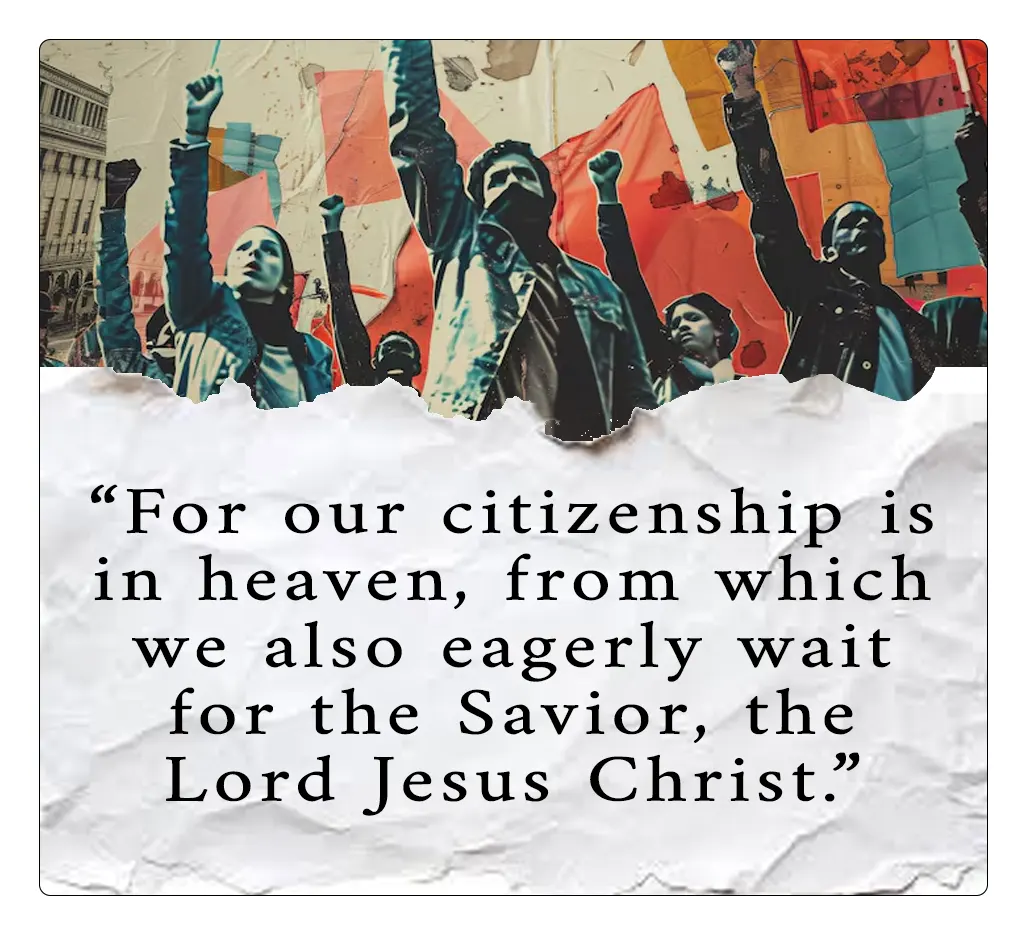
Our citizenship is in Heaven, not in the systems of man; for nations rise and fall, but the soul endures forever.
I live in America—a nation rich with Books & Links and overflowing with opportunity. Yet instead of responding with gratitude for God’s grace in allowing us to live in such a place, we have become narcissistic, arrogant, and deeply divided. And this spirit is not unique to Americans; people across the world are increasingly exalting their nations above all else.
But God is not concerned with countries, political systems, or even the idea of building a “nation under God.” His heart is for people, not politics. His desire is not to establish earthly governments but to rescue souls. When love of country or political allegiance takes priority—especially among Christians—it breeds division, fuels wars, and ultimately becomes idolatry. (Matthew 6:33)
Remember the Call
God’s desire for His creation is twofold: first, that all would find salvation in Him; and second, that those who are saved would help lead others to the same door of life. God’s work is about souls. Every second, every minute, every hour, He is adding to His Kingdom (2 Peter 3:9).
His invitation is simple yet profound: to be His family—He the Father, we His children, His Kingdom our home. But humanity turned away. Sin entered the world, separating us from God, leaving us exiled in a fallen world that is not our true home. (Romans 3:23)
Government in God’s Plan
In the Old Testament, God did establish systems of government—through Moses, through judges, and later through kings. These systems were never meant to exalt rulers but to maintain order, restrain chaos, and keep people from destroying one another. They were temporary scaffolding, not eternal solutions.
God never desired Israel to have a king at all. Yet when the people demanded one, He gave them Saul—an unfaithful leader. Through this, God showed that He often allows us the leaders we deserve. At times, they may be wise; at other times, corrupt. But always, He uses them to remind us that no human government can ever create a godly society.
This is why Paul urged believers to pray for their leaders (1 Timothy 2:1–2)—not because politics can save, but because prayer keeps us aligned with God’s purposes. Sometimes, He even permits ungodly rulers to rise in order to awaken people to their need for Him. His mission has never been to build governments, but to save souls.
The Corruption of Politics
Let us not be naive: most of what we call government and politics is corrupt, driven by pride, greed, and the pursuit of power. And if anyone dares to stand firm in righteousness, they are quickly silenced or cast aside, for the path upward demands compromise. Scripture has long shown that earthly rulers are no different—each flawed, none righteous. (Psalm 146:3)
The American government is no exception. Though it may claim to honor God, it does so not through the Spirit but by appealing to His laws—laws it quickly compromises whenever self-interest demands it. As Isaiah warned, “Woe to those who call evil good and good evil” (Isaiah 5:20).
One day, Christ Himself will reign—not through politics or human systems, but through His Spirit and His eternal Kingdom. Until then, governments may serve as a temporary guardrail, like the law of Moses, but they can never replace Christ (Galatians 3:24).
Nation Under God
It is often said that America’s forefathers were Christians who fought to establish a nation under God. And in many cases, this is true. But their intent reveals the flaw. They carried forward what God had once given in the Old Testament—a structure to control and restrain people—and used it for the same purpose. Their focus was not on salvation but on protecting freedoms, rights, and comforts.
Our desire to build a “nation under God” has only caused us to cling to this world as if it were our true home. We fight to preserve its rights and freedoms, yet Scripture warns: “Do not love the world or the things in the world” (1 John 2:15). When we place our devotion in a country, it becomes idolatry.
Jesus calls us to die to ourselves (Luke 9:23), and that includes letting go of pride in earthly nations. Yet many cling tightly to their country, believing they must defend it. This leads to walls—walls that divide.
How can we truly care about souls, or join God in His mission to save, if we are busy building barriers? Jesus commanded us to love our neighbors, and by “neighbor,” He meant the world (Luke 10:27–37). How can we invite people to Heaven, while refusing them as neighbors here on earth?
Fear of Darkness
Many ask: Are we just supposed to sit back and let the world grow darker? Should we allow society to slip further from God’s standards? It’s a fearful thought—especially for parents worried about the world their children will inherit.
But this is exactly where our trust in God must grow stronger. He is sovereign, and He will accomplish His purposes. Our calling is not to control the world, but to be salt and light within it (Matthew 5:13–16), no matter how dark it becomes. We are called to live out the gospel and proclaim it with our words and our lives.
When we try to force people to live under God’s standards, it never produces salvation. At best, it creates empty religion and deeper division. True transformation comes only through Christ, not through imposed rules. (Romans 12:2)
So we must ask: if Heaven is our home and this world is a prison, why are we so intent on making the prison more comfortable? Often it is fear—fear that the prison will grow more evil. But are we more concerned about rescuing souls, or about preserving our own rights and comforts?
The Example of Christ
Jesus did not cling to His rights. Instead, He laid them down on the cross for the sake of love (Philippians 2:6–8). Scripture foretold that the world would turn away from God, as in the days of Noah and Sodom and Gomorrah (Luke 17:26–30). And what happens when people reject God’s truth? Paul tells us:
“Therefore God also gave them up to uncleanness, in the lusts of their hearts, to dishonor their bodies among themselves, who exchanged the truth of God for the lie, and worshiped and served the creature rather than the Creator, who is blessed forever. Amen” (Romans 1:24–25).
Yet even in the deepest darkness, the light of salvation shines the brightest. This is our calling as Christians—not to build kingdoms of comfort, but to shine as beacons of Christ’s love and truth. (John 8:12)
Our True Citizenship
Does this mean we should avoid politics or withdraw from the world? No. It means we engage, but not to force change or impose rules. We engage to point people to a greater hope—a better life to come in Christ. In all we do, we must ask: “How does this add to God’s Kingdom?” That is all that matters.
As Christians, we are called to respect and submit to governing authorities, fulfilling our civic duties (Romans 13:1–7). Yet our ultimate allegiance is to God—when human laws conflict with His commands, we obey Him first (Acts 5:29). We also recognize that our hearts and energy should not be consumed by politics; as Jesus said, “Give to Caesar what is Caesar’s, and to God what is God’s” (Matthew 22:21).
If God’s plan was for His people to transform the world through politics, then Jesus, the apostles, and the saints of the New Testament failed—for none of them sought political power. Even when the crowds tried to make Jesus king, He refused (John 6:15). His Kingdom is not of this world (John 18:36).
The Jewish people longed for God to rescue them and establish His reign on earth. Yet Christ came humbly as a servant, giving His life and pointing us to the Kingdom of Heaven. He did not entangle Himself in the governments of His day, but reminded us that this world is not our home.
God is offering us a place in His eternal Kingdom. Therefore, let us not waste our lives building earthly kingdoms. Instead, let us store up treasures in Heaven (Matthew 6:19–21), where they will last forever.
As Christians, our calling is clear: engage with the world wisely, not to impose rules or political agendas, but to point others to Christ. Prioritize the salvation of souls over earthly systems, and invest your time, energy, and Books & Links in eternal treasures rather than temporary comforts. In all things, let God’s Kingdom guide your heart, your choices, and your actions.
Seek first God’s Kingdom, shine His light, and invest in what lasts forever—souls, not systems. (Colossians 3:2)