Kill the Flesh or It Will Kill Your Faith
The Christian Path
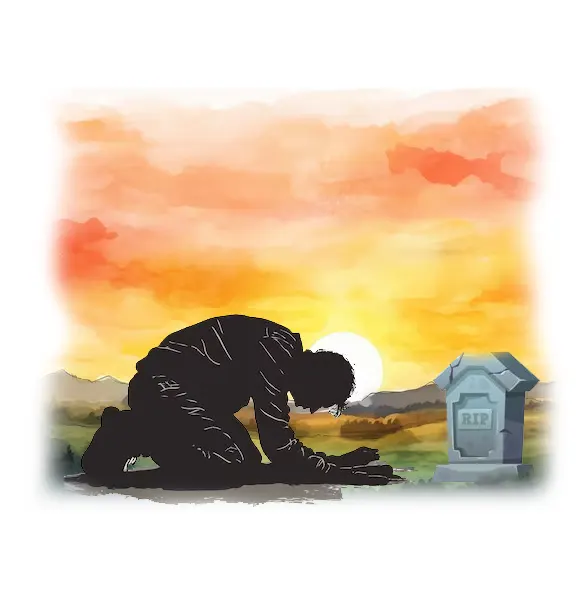
Death gives birth to the seed of Christ
When I first got saved, I threw myself into church life with passion. But no one told me about the step that should have come first—the step that makes everything else possible.
Dying to self.
Inside all of us lives the flesh—restless, monstrous, determined to be its own god. It wants nothing to do with the true God. Scripture is clear: it must die (Galatians 5:24; Romans 8:13).
But this is not a one-time execution. The flesh never stays buried. Every morning, it waits—ready to rise, ready to rule. Hostile to God, obedient to Satan, it will drag us off the path of Christ if we let it live (Romans 8:7).
The flesh is not our companion. It is our enemy. And unless it dies daily, it will control us (Luke 9:23).
Following Jesus in the flesh always ends the same way: confusion, exhaustion, and burnout. Without surrender, clarity disappears, strength drains, direction fades. The Christian life turns into a weary cycle—plenty of effort, little fruit, and a soul running on empty.
You can read Scripture daily, attend every small group, and hear sermon after sermon—but if the flesh rules, it’s like going to war with the enemy at your side. The flesh doesn’t understand the battle. It doesn’t want the battle. Every time you step toward Jesus, it pulls the other way (Galatians 5:17).
Until the flesh is crucified, it will always sabotage the walk.
God’s Appeal
Dying to self is not a suggestion—it is God’s appeal.
In Romans 1–11, Paul lays the foundation of the Gospel: every person is guilty under sin, Christ died and rose again, and through Him we are freed from sin’s grip and empowered to live by the Spirit. Then comes the turning point:
“I appeal to you therefore, brothers, by the mercies of God, to present your bodies as a living sacrifice, holy and acceptable to God, which is your spiritual worship. Do not be conformed to this world, but be transformed by the renewal of your mind.” (Romans 12:1–2)
This is where Christian living begins. Paul doesn’t offer advice; he pleads for surrender. Every thought, every desire, every ambition—laid at God’s feet. To say, “God, I’m all in,” is to say, “My flesh is all out.”
That is what it means to present ourselves as living sacrifices: to drag our flesh to God’s altar and leave it there daily.
Pastor Chip Ingram compares this surrender to signing a blank check and handing it to God—no conditions, no limits, no fine print. Everything we are, placed in His hands. Only there—at the altar, with the blank check signed—does transformation begin.
Do Not Be Conformed
Dying daily means refusing to be shaped by the world. Our minds must be set on the Kingdom, not the patterns of this age. We live here, but we live by God’s commands—His standard, not the world’s (Romans 12:2; 1 John 2:15).
That obedience will cost us. It always does. But we are not called to think like the world, believe like the world, or follow its mindset. We are called to follow God—without compromise (James 4:4).
Starve the Flesh
We cannot feed the flesh and expect to walk in the Spirit. Every time we give the flesh what it wants, it grows stronger, and Satan gains ground.
What does feeding the flesh look like? It looks like giving time, attention, and affection to anything that opposes God—indulging impurity, tolerating sin, consuming what dulls His voice, or seeking approval by laughing at what He hates.
Paul lists the works of the flesh—sexual immorality, impurity, idolatry, jealousy, anger, and more (Galatians 5:19–21). But feeding the flesh is not always obvious. It can be subtle—the shows we watch, the voices we let influence us, the environments we choose. If it counters God, it strengthens the flesh.
Here’s the test: Whatever you do, read, or watch—would you invite Jesus to join you? Because He’s already there. His Spirit lives within us. Our bodies, our minds, our choices—they are not our own. They belong to Christ (1 Corinthians 6:19–20).
So starve the flesh. Feed the Spirit. Only then will your life bear Kingdom fruit.
Feed the Spirit
If the flesh grows by what we feed it, then the Spirit must also be nourished. Feeding the Spirit strengthens our life in God and gives us power to overcome the flesh.
We feed the Spirit by soaking in God’s Word—studying, meditating, and letting it reshape us (Psalm 1:2–3). We feed the Spirit through prayer and worship—drawing near to God, receiving His strength (Hebrews 4:16). We feed the Spirit when we invite Him to examine our lives, convict us, guide us, and prune us (Psalm 139:23–24).
This is not passive. It is wrestling with God, seeking His leading, submitting to His refining hand.
And when the Spirit is fed, fruit comes: love, joy, peace, patience, kindness, goodness, faithfulness, gentleness, and self-control (Galatians 5:22–23). The life of Christ rises in us, and that fruit becomes the weapon that destroys the works of the flesh.
The Danger of Living Without Dying
Many Christians try to follow Jesus without dying daily. They think church, Bible study, and serving will silence the flesh. And for a while, it seems to work. But the flesh waits—for weakness, for compromise—and then it rises.
At first, our faith burns bright. But if the fire isn’t fed, it fades. Living on the high of salvation while draining our spiritual tank leads to stagnation. That’s when the flesh whispers again, promising pleasure. And for a moment it may satisfy—but afterward, we’re left emptier, ashamed, knowing we’ve been feeding on garbage.
Without growth, we remain spiritual children. And that is what the flesh is: immaturity. It is selfish, stubborn, blind to its own destruction. Following Jesus in that state is like trying to walk His path as a child who refuses to grow up. We lose sight of Him. We fail to hear His voice. We wander constantly (Ephesians 4:14).
In that state, sermons and studies barely sink in. Real change stalls. We are tossed back and forth, unstable and ungrounded.
Following Jesus as spiritual infants is no different than walking in the flesh. It’s like trying to follow Him while sinking in quicksand—struggling, stuck, and slowly being swallowed.
Where It Begins
When I became a Christian, I learned that Scripture called me to die to myself. But I didn’t realize how much my faith would suffer without doing it daily. I struggled to grow, struggled to let go, struggled to carry His light into a broken world.
The truth is simple: the flesh must die. If we refuse to crucify it, our faith will stay shallow—weak, lifeless, powerless. But if we surrender—if we put it to death—transformation begins. God is glorified. Faith comes alive (Romans 6:11; Colossians 3:5).
If we are going to run the race marked out for us, it has to begin here: with our death, so that Christ can fully live through us (Hebrews 12:1–2; Galatians 2:20).
Summary
“Fight the good fight of faith. Take hold of the eternal life to which you were called.” ~ 1 Timothy 6:12